
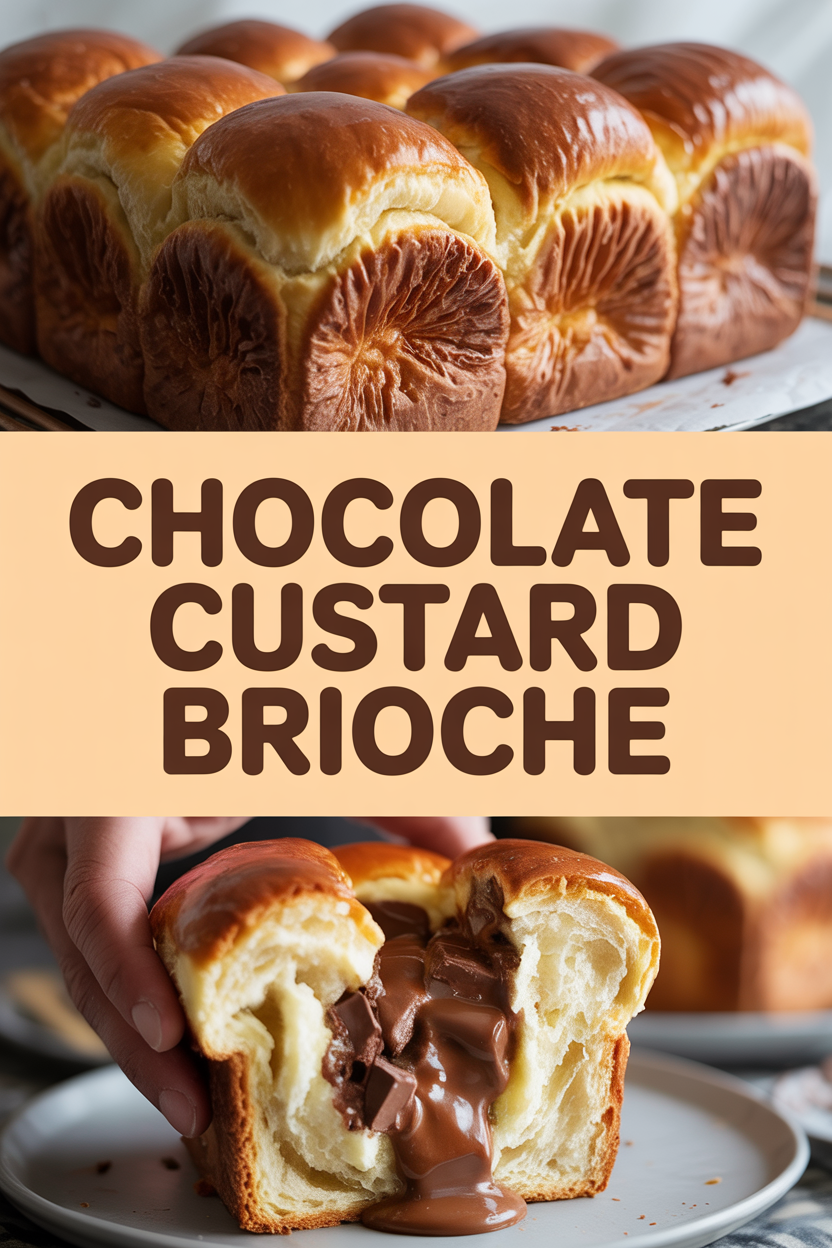
When I smell warm brioche, I time-travel back to my grandmother’s tiny kitchen where mornings tasted like butter and gossip. She would tuck a spoonful of thick chocolate custard into a soft roll and hand it over with a wink: “Eat before it gets cold.” That sticky, glossy bite — warm custard melting into pillowy bread — stuck with me. I recreated that magic in this Chocolate Custard Brioche, keeping the dough rich but forgiving and the custard silky with real chocolate. It makes the house smell like Sunday mornings, and it rewards patience with a crust that whispers when you break it and a center that luxuriously puddles chocolate. Trust me: you’ll want to curl up with one and never share (or maybe just one).
Quick Facts
- Yield: Serves 6–8
- Prep Time: 45 minutes active (plus 1½–2 hours rising)
- Cook Time: 25 minutes
- Total Time: 3 hours (including rises and cooling)
Why This Recipe is Awesome
This recipe gives you pillowy, buttery brioche with a molten chocolate custard center — crisp, golden exterior and gooey, chocolatey heart. It tastes like a bakery steal but stays firmly in home-cook territory: no tempering chocolate or fancy equipment. The dough stays soft and springy, the custard stays shiny and spoonable, and the kitchen fills with warm, sweet aromas that make neighbors curious. Plus, it’s so doable that your oven will basically high-five you.
Ingredients
For the Main Dish:
- 3 cups all-purpose flour
- 1/4 cup granulated sugar
- 1 packet (2 1/4 tsp) instant yeast
- 1 tsp fine salt
- 3 large eggs, room temperature
- 1/3 cup whole milk, warmed to about 100–110°F
- 1/2 cup (1 stick) unsalted butter, softened and cut into tablespoons
- 1 tsp vanilla extract
For the Chocolate Custard:
- 1 cup whole milk
- 1/2 cup heavy cream
- 1/3 cup granulated sugar
- 3 large egg yolks
- 2 tbsp cornstarch
- 4 oz semisweet chocolate, finely chopped (or chocolate chips)
- 1 tbsp butter (optional, for sheen)
- 1 tsp vanilla extract
For Finishing / Garnish:
- 1 egg beaten with 1 tbsp water for egg wash
- Powdered sugar for dusting (optional)
- Flaky sea salt or chopped toasted hazelnuts (optional)
How I Make It
Step 1:
In my stand mixer bowl, I whisk together the 3 cups flour, 1/4 cup sugar, 1 packet yeast, and 1 tsp salt. I add the 3 eggs, warmed 1/3 cup milk, and 1 tsp vanilla, then mix with the dough hook on low until shaggy. I add the softened butter a tablespoon at a time, letting the dough knead until it becomes smooth and elastic — about 8–10 minutes
I transfer the dough to a lightly oiled bowl, cover it, and let it rise until doubled — about 60–90 minutes depending on room temp. While the dough rises, I make the custard. I warm 1 cup milk and 1/2 cup heavy cream until steaming but not boiling. In a bowl, I whisk 3 egg yolks, 1/3 cup sugar, and 2 tbsp cornstarch until smooth. I temper the yolks by slowly whisking a ladle of hot milk into them, then pour the mix back into the saucepan. I cook over medium heat, whisking constantly, until it thickens and coats the back of a spoon — about 3–5 minutes. Off heat, I stir in the 4 oz chopped chocolate, 1 tbsp butter, and 1 tsp vanilla until glossy. I chill the custard while the dough finishes rising; cold custard is easier to pipe. I punch down the dough, divide it into 8 balls (~100–110g each), flatten each into a disc, and spoon or pipe 1–2 tbsp of chilled chocolate custard in the center. I pinch the edges closed, roll gently to smooth, and place seams down on a baking sheet lined with parchment. After a quick second rise — about 30–40 minutes until puffy — I brush with egg wash and bake at 375°F for 18–22 minutes, until the tops become deep golden and the house smells like butter and chocolate. I let the buns cool for at least 10 minutes so the custard firms slightly (but stays molten). I dust with powdered sugar and sprinkle a little flaky sea salt or chopped nuts if I feel fancy. Serve warm for the best gooey center; you’ll hear the soft sigh when you break one open. I serve these warm for breakfast with a big mug of coffee or an afternoon tea. They shine at weekend brunch or as a show-off dessert for dinner parties — fancy enough to impress, easy enough to enjoy with sticky fingers. In summer I pair them with fresh berries; in winter I sip spiced hot chocolate alongside. Closing: Now go impress someone — or just yourself — with your homemade masterpiece of warm, chocolatey brioche!Step 2:
Step 3:
Step 4:
Step 5:
Pro Tips
Common Mistakes to Avoid
Alternatives & Substitutions
Variations & Tips
FAQ (Frequently Asked Questions)
How I Like to Serve It
Notes
Final Thoughts